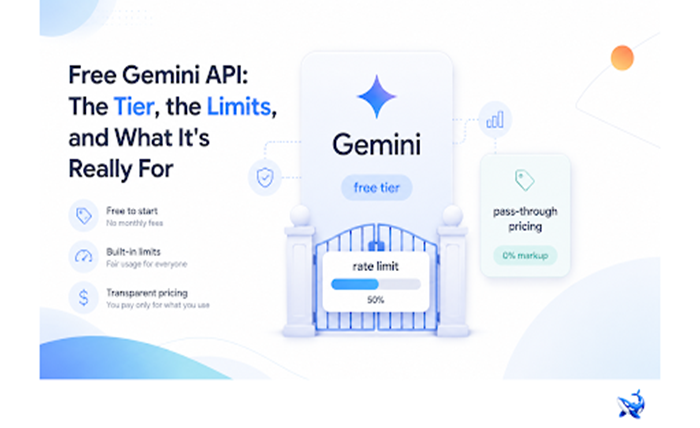
A free Gemini API gets you Google’s models at $0, and the current rate card for Gemini 3.5 Flash shows how cheap the Flash tier already is — the free tier is a step below even that. That gap is the whole story of this article: free Gemini is real, and it sits just above the floor of a market that has been driving the cost of capable models toward zero.
Searching for a free Gemini API usually means a developer wants to write against Google’s strong multimodal and long-context models without setting up a paid account, or a team wants to check whether Gemini beats its current model before moving anything. The models are genuinely worth evaluating — Gemini’s Flash line is a serious contender on cost-per-task. The free tier is the way in, and the quota is the thing that decides whether the evaluation is meaningful.
What the Gemini free tier gives you
The free tier on Gemini — whether through Google directly or a platform that fronts the same models — gives you real Gemini access bounded by rate limits and a token budget. That’s enough to run a genuine evaluation, and that’s what it’s for.
You can exercise the Flash model on real prompts, measure its output quality against your bar, and compare it to the model you’re already running. On a small volume, the free tier is a perfectly fair test bed. Where it breaks is the same place every free tier breaks: under sustained or bursty load, the cap turns your request into an error, and a model that’s free at 10 requests a minute is not a model you can put on a customer path.
The useful framing is that Gemini’s Flash tier is already very cheap, which makes the free tier a convenience more than a necessity. If the free quota is tight and the work is routine, paying list price for Flash might be a better use of your time than dancing around a cap — which is worth remembering before you invest engineering effort in a free budget.
The two limits that actually matter
Before you build around the free tier, check the two numbers that determine whether it’ll hold.
Requests and tokens per minute. This is the one that bites. An agent loop that retries and re-prompts burns tokens far faster than a single prompt, and the free tier’s per-minute cap is usually sized for the latter. Compute your loop’s burn, not just the headline rate.
The model versus the one you’ll pay for. Confirm the free tier serves the Gemini model you think — Flash, or something smaller — and not a downgraded variant. If the free entry is a weaker model, the quality you measured is not what you’ll get when you move to paid. Pin the model ID.
Both point the same direction: the free Gemini tier is a rapid way to find out whether Gemini deserves a slot in your stack, not a way to run a production workload.
When the free tier becomes the wrong choice
Free tiers cost you attention, and attention is not on the invoice. The cap you monitor, the retry logic you write, the errors you handle — that’s real engineering time. For a short evaluation, it’s a fair trade. For a workload that runs continuously, the math flips: the money the free tier saves is smaller than the time it eats.
The cleaner path is usually to pay list price for the model that clears your bar, at the vendor’s own rate. For a Flash-tier model that’s already inexpensive, the jump from free to paid is a rounding error, and it buys you predictability. A router that passes that list price through at 0% markup makes the price you plan against the price you pay — no platform fee to distort the comparison [OURS].
Why a single key makes free tiers usable
The practical annoyance of free tiers is that they’re per-vendor. A Gemini budget, an OpenAI budget, a Claude budget — three keys, three quotas, three sets of limits. The free tier becomes the thing you maintain. An aggregator collapses all of it: one key reaches the whole catalog, and a router decides per prompt which model and which tier to use — free Gemini Flash for the easy bulk, a paid frontier model only when the task needs it [OURS]. You’re no longer managing three free budgets; you’re picking the best model for each request [OURS].
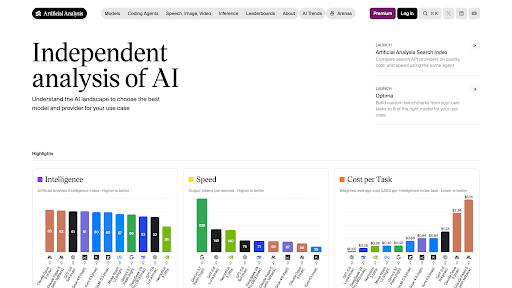
The arithmetic of free versus Flash at list price
The honest question when a free Gemini tier is tight isn’t “how do I get more free” — it’s “what would it actually cost to just pay the list price.” Run the numbers and the answer is often surprisingly small. A Flash-tier model at a few dollars per million tokens, on a workload of a few hundred thousand tokens a day, costs cents. The free tier saves you cents a day and costs you the time to monitor its cap and write around its errors.
That trade flips the decision. Free is worth it when the workload is a weekend evaluation or a low-volume test, where the cap is irrelevant. It is not worth it once the workload is steady, because the maintenance time is worth more than the cents the free tier saves. Many teams discover that the moment they run this arithmetic on their own token counts, and the answer is usually “just pay the list price.”
The practical setup that respects both is a router that knows what each request is worth: the free or near-free open tier for routine work, a paid model at list price for the prompts that need it, and one key across both [OURS]. That way the cheap thing stays cheap, the expensive thing is only used where it earns its cost, and you are never managing three quotas to save cents.
The takeaway
A free Gemini API is a quick, honest way to test whether Google’s models earn a place in your stack, and Gemini’s Flash line is genuinely cheap enough that the free tier is a convenience rather than a necessity. Use it to evaluate, log what you run, and check both the per-minute cap and the exact model ID. When the evaluation turns into a workload, pay the vendor’s list price for the model that clears your bar — reached by one key instead of a quota per lab — and let free be the step it was meant to be.
Sourcing note: Gemini 3.5 Flash’s price and context figures are vendor-reported from Google’s rate card, checked 2026-08-22. OrcaRouter product facts (one key for 200+ models, per-prompt routing, 0% markup pass-through) are from its official site, checked 2026-08-22. Free-tier quotas and Gemini prices change without notice.