Football is a popular sport worldwide, but not everyone knows the exact dimensions of a playing field. One of the questions many people are interested in is How many meters wide is a football pitch? The answer depends not only on the type of pitch but also on the level of competition and the regulations of the organizing body.
According to the Laws of the Game issued by IFAB, a football pitch does not have one single fixed size. The length and width are specified within certain ranges to accommodate different pitch conditions. For international matches, the permitted range is narrower to ensure greater consistency. When watching football on 90 Phút TV, fans can easily notice differences in the playing space between stadiums.
What Are the Dimensions of a Standard Football Pitch?
According to Law 1 of IFAB, a rectangular football pitch has a length of 90 to 120 m and a width of 45 to 90 m. For international matches, the length ranges from 100 to 110 m, while the width ranges from 64 to 75 m.
Therefore, if asking How many meters wide is a football pitch?, it can be understood that the width of a standard football pitch is not fixed at one single number. A regular pitch can be 45 to 90 m wide, while a pitch used for international matches must be between 64 and 75 m wide.
This flexibility allows stadiums in different countries to meet varying terrain and infrastructure conditions. However, for major professional competitions, organizers generally choose pitch dimensions that are suitable for international standards.
How Wide Is an International Football Pitch?
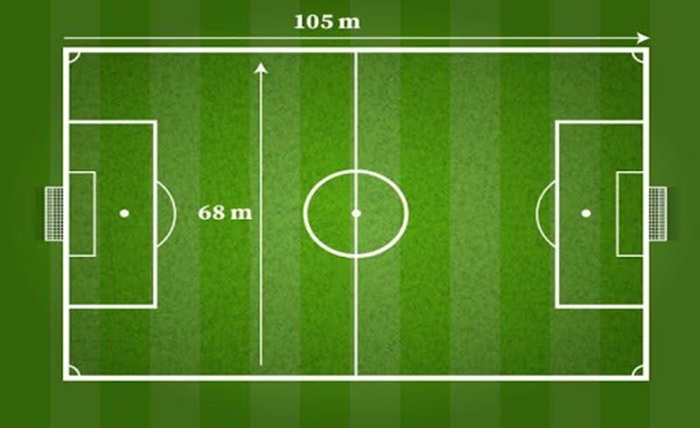
For international matches, the pitch width ranges from 64 to 75 m. In practice, many professional stadiums choose a width of around 68 m to create a balance between attacking and defensive space.
A wider pitch gives teams better conditions to move the ball toward both flanks, stretch the defensive line, and exploit available spaces. Conversely, a narrower pitch reduces the distance between players, which can increase the density of challenges in central areas.
This is also a factor that fans can observe when xem trực tiếp bóng đá hôm nay. Teams that prefer possession-based football often make use of the pitch width to stretch the opponent’s defensive structure.
The playing fields of top clubs are usually designed in a highly systematic way, ensuring appropriate distances between the touchlines, stands, and functional areas according to competition requirements.
How Wide Is an 11-a-Side Football Pitch?
An 11-a-side football pitch is the most common type of field in professional football. Under general regulations, the width can range from 45 to 90 m, while international matches apply a range of 64 to 75 m.
In practice, dimensions of 105 x 68 m are very commonly used at professional stadiums. This is also a size frequently selected when building pitches for high-level matches.
If a pitch is 105 m long and 68 m wide, its playing area is 7,140 m². This space is large enough for 22 players to compete while also providing the necessary room for different tactical approaches.
Fans watching 90Phut TV can notice that teams focused on attacking through the flanks often make maximum use of the pitch’s width. Wingers have plenty of space to accelerate, dribble, and deliver passes into the penalty area.
Why Does Pitch Width Affect Tactics?
The dimensions of the playing field directly affect how a team operates tactically. When the pitch is wide, players have more space to move and combine. A possession-oriented team can use passes toward both wings to stretch the defensive line.
If the pitch is relatively narrow, defenders can maintain their formation more easily. As a result, the space between the lines becomes smaller, making it more difficult for opponents to exploit attacking situations in the two wide channels.
Therefore, the question How many meters wide is a football pitch? is not only related to pitch construction but also has tactical significance. A difference of just a few meters in width can affect how a team builds attacks, presses, and transitions between phases.
People who frequently watch live football today can clearly see this difference through the way teams use the width of the pitch. In particular, teams playing with a 4-3-3 or 3-4-3 formation often make extensive use of the two flanks.
How Is the Penalty Area Arranged?
In addition to the overall dimensions, a football pitch also contains many areas that are specifically regulated. The penalty area is formed by two lines perpendicular to the goal line and extending 16.5 m into the field, connected by a line parallel to the goal line.
This area has particular significance because the goalkeeper is allowed to use their hands within their own team’s penalty area. Serious fouls committed by defending players in this area can also result in a penalty kick.
In addition to the penalty area, the pitch includes the goal area, penalty mark, corner arc, and center circle. All of these are clearly marked with lines to assist referees and players.
On 90 Phút TV, situations occurring inside the penalty area are always among the most attention-grabbing content because a single foul can change the course of a match.
Is Goal Size Related to Pitch Width?
An 11-a-side football goal is 7.32 m wide and 2.44 m high. These are standard dimensions used in professional and international matches.
Compared with the total width of the pitch, the goal is relatively small. This creates a major challenge for attacking players, who must find ways to get the ball into the net between the defensive line and goalkeeper.
The distance from the touchline to the goal area also contributes to the tactical space available. Wingers can use this channel to deliver crosses or low balls across the box.
When watching highlight bóng đá việt nam, viewers often encounter attacking situations from both wings before the ball is delivered into dangerous areas. This is one of the common ways to take advantage of the width of the pitch.
Is a Mini Football Pitch as Wide as an 11-a-Side Pitch?
No. A mini football pitch is much smaller than an 11-a-side pitch and is usually designed for 5-a-side or 7-a-side football. The specific dimensions depend on the type of pitch, competition, and regulations of the organizing body.
A 5-a-side pitch usually has a small playing area suitable for a limited number of players. Due to the restricted space, combinations happen quickly and players must control the ball within tight areas.
A 7-a-side pitch is larger but still significantly smaller than an 11-a-side pitch. This creates considerable differences in tactics, the speed of ball circulation, and players’ movement within available space.
Therefore, when asking How many meters wide is a football pitch?, readers need to determine whether they are referring to a 5-a-side, 7-a-side, or 11-a-side pitch. The dimensions of one type of pitch should not be applied to all types.
90m TV often focuses on various types of football content, so fans can clearly encounter differences between different types of pitches when following matches played under various formats.
How Does the Playing Surface Affect Match Quality?
In addition to length and width, the quality of the playing surface also has a significant impact on a match. Natural grass pitches need regular maintenance to ensure proper flatness, moisture levels, and drainage capacity.
Modern stadiums may use drainage systems beneath the grass surface to limit waterlogging during rainy weather. Some stadiums also use hybrid or artificial grass depending on climate conditions and intended use.
A good playing surface helps the ball roll consistently, allowing players to make accurate passes. Conversely, a deteriorating surface can cause the ball to bounce unpredictably and affect the technical quality of the match.
When watching 90P TV, fans can easily notice how pitch quality clearly affects the speed of ball circulation and players’ ability to control the ball.
Standards That Need to Be Ensured When Building a Pitch
A professional football pitch not only needs to meet the required dimensions but must also satisfy many other standards. The pitch markings must be clear, the goalposts must be securely fixed, and the areas surrounding the pitch must ensure player safety.
In addition, large stadiums need lighting systems, changing rooms, technical areas, referee rooms, and facilities for spectators. For international competitions, infrastructure requirements are generally much higher than those for ordinary football pitches.
Choosing appropriate pitch dimensions also helps organizers ensure match quality. Professional clubs often prioritize common dimensions so that players can adapt well to different stadiums.
Images of highlight bóng đá việt nam also show that many stadiums domestically are being improved in terms of grass surfaces, lighting systems, and infrastructure to serve professional matches.
Conclusion
Based on the information above, the answer to How many meters wide is a football pitch? is that an 11-a-side pitch has a width of 45 to 90 m under general regulations, while a pitch used for international matches has a width of 64 to 75 m. A common size at many professional stadiums is approximately 68 m wide and 105 m long.
Through 90 Phut, viewers can observe how teams make use of the width of the pitch in real matches. At the same time, highlight bóng đá việt nam videos also allow viewers to look back at attacking situations, goals, and notable plays created from both wide channels.